
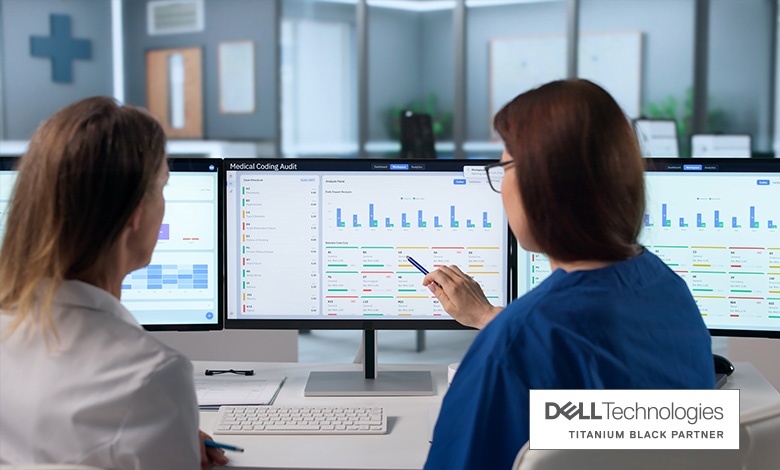
Healthcare organizations are generating more data than ever before. From electronic health records (EHRs) and medical imaging to genomics, digital pathology, clinical research, and connected medical devices, the volume and complexity of healthcare data continue to accelerate. Yet for many healthcare IT leaders, the challenge is no longer simply collecting data. It is determining how to securely manage it, derive value from it, and leverage it to drive better patient, operational, and research outcomes.
As artificial intelligence has moved from experimentation to implementation, healthcare organizations are discovering that successful AI initiatives depend on something far more fundamental than algorithms: a modern data and infrastructure strategy.
The Growing Healthcare Data Challenge
Healthcare data is unique. It is highly regulated, increasingly unstructured, and often distributed across shared storage platforms, where different file types and metadata formats require distinct methods for indexing, cataloging, and analysis. Medical imaging, in particular, represents a significant portion of a health system’s data and contains a large repository of underutilized clinical insight. To unlock that value for analytics, research, and AI initiatives, organizations need platforms that can read and interpret metadata embedded in formats such as DICOM headers, while also connecting that insight with other clinical, operational, and research data sources.
For many organizations, data growth is creating several critical challenges:
- Managing rapidly expanding storage requirements
- Securing sensitive patient and research information
- Governing access across multiple stakeholders
- Integrating disparate data sources
- Supporting increasingly AI-driven workflows
- Controlling the cost of cloud-based AI services
Many healthcare organizations have accumulated decades of valuable information but lack the tools and infrastructure necessary to effectively utilize it. As AI adoption increases, addressing these challenges becomes a strategic imperative.
Why AI Success Starts with Data
The healthcare industry is embracing AI to improve diagnostics, accelerate research, automate workflows, and enhance patient experiences. However, AI models are only as effective as the data that supports them.
Before deploying AI initiatives, healthcare organizations must answer several foundational questions:
- Do we know where all of our data resides?
- Can we easily access and govern that data?
- Are we prepared to support large-scale AI processing workloads?
- Can we maintain appropriate security and compliance controls?
- Do we have the infrastructure necessary to support both current and future AI initiatives?
Without strong data governance and infrastructure, AI projects often stall before reaching production.
The Rise of Sovereign AI in Healthcare
One of the emerging priorities among healthcare providers is sovereign AI, an approach that enables organizations to maintain greater control over their data, models, and outcomes. For healthcare IT leaders, sovereign AI offers several important advantages:
- Enhanced Security and Compliance—Sensitive healthcare information remains within organizational control, supporting compliance requirements and reducing exposure to external risks.
- Greater Data Governance—Organizations can define exactly who has access to specific datasets, how models interact with information, and how outputs are used across clinical and operational environments.
- Predictable Cost Management—As AI adoption expands, token-based consumption models can create budget constraints that limit experimentation and force research teams to prioritize projects based on usage costs. On-premises and hybrid AI approaches can help remove that barrier by providing more predictable operating costs, enabling researchers to explore more ideas, scale promising initiatives, and accelerate innovation without being constrained by token budgets.
- Reduced Latency and Faster Insights—Keeping data closer to where it is generated enables faster processing and analysis, an important consideration for research, imaging, diagnostics, and clinical decision support applications.
Modernizing Infrastructure for Healthcare AI
Supporting AI workloads requires more than additional server capacity. Healthcare organizations need infrastructure designed to handle the performance demands of modern analytics, machine learning, and large language models. Dell Technologies addresses this challenge through an integrated portfolio of AI-ready infrastructure, data platforms, storage solutions, and services designed to help organizations accelerate adoption while maintaining security and governance.
Key capabilities include:
- AI Infrastructure at Any Scale—Not every healthcare organization needs a massive AI cluster. Some require solutions for large-scale research and model training, while others need targeted systems supporting specific use cases such as radiology analysis, genomics workflows, or operational automation. Dell’s AI portfolio enables healthcare organizations to deploy infrastructure that aligns with their specific requirements, whether supporting a single AI application or an enterprise-wide AI strategy.
- Pre-validated AI Solutions—To simplify deployment and reduce complexity, Dell offers AI Factory with NVIDIA solutions that combine compute, storage, networking, and software into validated architectures designed to accelerate time-to-value. These pre-configured solutions reduce implementation complexity and allow organizations to focus on innovation rather than infrastructure design.
- Flexible Hybrid and On-premises Architectures—Healthcare organizations continue to evaluate where AI workloads should run. Dell supports a range of deployment models, including on-premises, hybrid, and colocation-based environments, helping healthcare IT leaders align infrastructure decisions with governance, compliance, and operational requirements.
Unlocking Value Through Unified Data Platforms
One of the biggest barriers to healthcare AI adoption is fragmented data. Organizations often struggle to connect data spread across EHR systems, imaging platforms, research databases, and other repositories.
Dell’s AI Data Platform helps address this challenge by enabling organizations to:
- Connect to existing data sources
- Analyze structured and unstructured data
- Create modern data lakehouse environments
- Support retrieval-augmented generation (RAG) workflows
- Accelerate AI and analytics initiatives
By creating a more unified view of healthcare data, organizations can move from isolated data silos toward enterprise-wide intelligence.
Accelerating Research and Precision Medicine
Advanced computing platforms are transforming research across healthcare and life sciences. Organizations are increasingly using AI and high-performance computing (HPC) to support:
- Genomics analysis
- Precision medicine initiatives
- Drug discovery
- Medical imaging research
- Clinical trial optimization
- Population health studies
- Clinical trials cohort selection
These workloads often require significant computational resources and specialized infrastructure. Dell’s HPC and AI solutions help organizations build environments that can efficiently process large datasets while enabling researchers to accelerate discovery.
The Critical Role of Secure Storage
Storage remains one of the most important components of any AI strategy. Healthcare organizations need storage solutions capable of supporting massive volumes of data while delivering the performance required for AI training, inferencing, and analytics.
Dell PowerScale provides scalable storage designed for AI workloads, enabling organizations to:
- Scale performance alongside capacity
- Support large AI datasets
- Improve throughput for analytics, machine learning, and model training and fine-tuning
- Manage both current and long-term data retention needs
As data volumes continue to grow, scalable storage becomes a critical enabler of healthcare innovation.
Turning AI Ambitions into Action
For healthcare IT leaders evaluating AI initiatives, the first step is often not selecting a model or use case. It is understanding their data. Organizations should begin by assessing:
- What data they have
- Where that data resides
- How it is governed
- Whether it can be securely accessed and analyzed
- What infrastructure is required to support future AI initiatives
A comprehensive data assessment often uncovers opportunities to improve efficiency, enhance decision-making, and accelerate AI readiness.
Building the Future of Healthcare Innovation
Healthcare organizations face growing pressure to improve patient outcomes, increase operational efficiency, strengthen cybersecurity, and advance clinical research. AI has the potential to support all of these objectives, but success depends on having the right foundation.
Connection and Dell Technologies work together to help healthcare organizations build that foundation through secure infrastructure, AI-ready data platforms, scalable storage, high-performance computing, and expert services. Together, we can help healthcare leaders modernize their data strategies, accelerate innovation, improve care delivery, and unlock the full potential of AI. Contact the Connection Account Team to learn more.
Andrea Ferrone

Andrea Ferrone is the Dell Healthcare Sr. Business Development Specialist at Connection, where she serves as the Dell Technologies expert for all healthcare providers. Andrea’s primary focus is to be a trusted partner for organizations navigating the complexities of modern healthcare. Her expertise ensures clients effectively integrate both Dell and Connection hardware, software, and services – including AI-ready infrastructure – to enhance patient care, secure data, and drive operational efficiency.