A few months ago, I had the worst roadside assistance experience of my life. That’s a bold statement—but let me set up the scenario. I travel quite a bit for work, and over time I have created routines to prepare and execute my trips with minimal obstacles. Despite my meticulous planning, I occasionally forget something essential. And in this case, it was my ONLY key to my vehicle, which I left in ANOTHER city! This brings us to the aggravating and time-consuming experience mentioned above.
A Roadside Assistance Headache Begins
Picture this situation. I arrive home late on a Friday evening and take the airport shuttle to the parking garage. When I walk up to my SUV, my proximity key doesn’t unlock the doors. Trying not to panic, I dig through my bags, but the key is nowhere to be found. I call my fiancé and explain the situation, reminding him that I have 24-hour roadside assistance, and let him know I will call him back with an update once I have more information.
Next, I dial the roadside assistance number posted on my car window. After navigating a few prompts, I reach a live representative and recount my predicament. The representative informs me that—because of my specific model—my vehicle will need to be towed to the nearest dealership to have a new key programmed. After confirming the details, they explain that a tow company will call shortly to verify my location and provide an estimated time of arrival. Though inconvenient, the towing service is covered, and I begin receiving automated text updates regarding the progress of my case.
When Automated Assistance Goes Wrong
Unfortunately, I assumed incorrectly this would be simply resolved. What followed next was an exhausting ordeal: it took a total of 37 phone calls—yes, you read that right—just to arrange for my car to be towed and to have a new key made. Throughout this process, I had to interact with four tow truck companies and three separate roadside assistance representatives. The situation required the dispatch of two types of tow trucks, and it led to two separate trips from the airport to my home and back again, as well as two visits to my car dealer. It was only through the support of one exceptional parts manager and a roadside assistance manager—whom I kept on speed dial—and a tremendous amount of patience over a span of 36 hours that I was finally able to get my car successfully towed and subsequent key made. While some complications could be attributed to the specific type of vehicle I own, most of the issues stemmed from communication system limitations. Although some of the tasks were automated, the lack of adaptability and interoperability resulted in frustrating loops and significant delays in achieving the final goal. Instead of streamlining the experience, the technology implemented created headaches for everyone involved. So, what’s next? Let’s discuss ways organizations can overcome automation challenges and greatly enhance end-user satisfaction by leveraging the newest technological innovations in automated processes.
The Evolution of Intelligent Automation
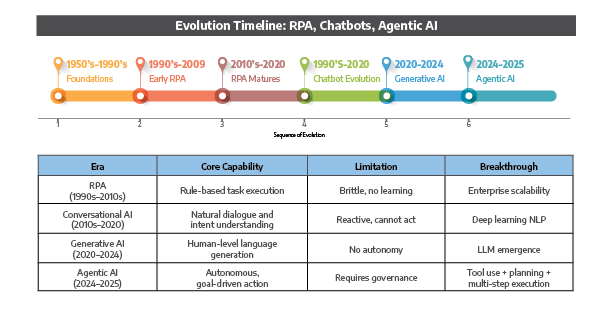
The foundation for chatbot logic and the future concept of AI agents was established by Alan Turing in the 1950s, when he first proposed the idea of machine intelligence. The earliest chatbots emerged in the 1960s, building upon his theories. By the 1990s and early 2000s, the evolution continued with the rise of Robotic Process Automation (RPA). RPA brought rule‑based task automation into the workplace, such as in call centers and manufacturing, where it replaced basic repetitive human tasks with technology-driven solutions.
As the technology matured, the following decade saw the emergence of cognitive automation—RPA enhanced by machine learning and AI-based decision making. This shift enabled automated systems to move beyond simple call trees and allowed them to interpret emails, documents, and images, and even make basic probabilistic decisions. The result was widespread adoption of these solutions across industries such as healthcare, banking, insurance, and HR operations.
In the 2010s, significant advances in Natural Language Processing (NLP) led to the birth of Conversational AI, and conversational assistants such as Siri emerged. Advances in NLP and deep learning enabled chatbots to understand intent, maintain context, and engage in more natural dialogue.
Within the last 5 years, and the arrival of Large Language Models (LLMs) such as ChatGPT, systems gained the ability to generate human‑like text and code, summarize and synthesize information, and handle unstructured inputs at scale. Though these digital assistants became conversational and context-aware, they remained primarily reactive: they could respond to queries but lacked the ability to autonomously act across multi-step workflows. This limitation was evident in my roadside assistance scenario, when it took 37 phone calls for an “automated system” to properly communicate information to complete a simple task; it lacked adaptability for the unknowns.
The Rise of Agentic AI: Autonomous Execution and Adaptability
In the past year, further technological advancements have ushered in the era of Agentic AI. This new class of artificial intelligence marks a transformative leap in automation. Agentic AI systems are not limited to generating responses—they are capable of taking autonomous actions to execute complete workflows and achieve multi-step objectives.
The distinction between AI agents and traditional RPA is not solely technical but philosophical. RPA executes exactly what it’s programmed to do—every action is predetermined and every decision hard-coded. In contrast, AI agents are provided with a goal and autonomously determine how best to accomplish it. With LLM reasoning, these agents can process ambiguous inputs, exercise judgment, and successfully navigate novel or unfamiliar scenarios. A current example of Agentic AI in action is its application within the Claims Management Cycle involving payors and providers.
Essentially, Agentic AI agents “learn and adapt” in ways that mirror human behavior. The integration of generative AI lifts automation beyond deterministic rules, enabling bots to interpret ambiguity, reason through uncertainty, and operate independently This level of adaptability is something traditional RPA could never achieve. Collectively, the convergence of these technologies signals a significant evolution: moving from the automation of discrete tasks to the automation of entire decisions, and ultimately, to the automation of outcomes.
Reflections on Technology Dependence and AI Implementation
This roadside assistance ordeal was a first world problem, but it prompted a deeper reflection on our dependence on technology, its reliability and the alignment of intent versus outcome. Working in the tech industry and assisting organizations with the implementation of technical solutions has given me a broader perspective on the far-reaching impacts these technologies can have. It is essential, as we plan and execute projects, to critically evaluate the limitations and scale of the tools we consider.
Gartner predicts 33% of enterprise software will incorporate agentic AI by 2028, and the market is projected to grow from $5.4 billion in 2024 to $47 billion by 2030. Agentic AI, though relatively new, will become part of the enterprise toolset fairly quickly. Effective planning for Agentic AI integration requires careful documentation of necessary tasks and scenarios that might arise during an interaction. It is crucial to involve the appropriate stakeholders, ensuring that we identify proper workflows and areas where flexibility is needed to accommodate exceptions or implement overrides. And recognizing when and how to introduce human intervention into automated and AI-driven processes is a vital part of this planning.
The Promises of Agentic AI: Designing Adaptive Systems for Optimal User Outcomes
Ultimately, our goal is to streamline workflows and improve performance or output for end users—whether they are knowledge workers, clinicians, or patients. Achieving this requires more than simply deploying advanced technologies; it involves a thoughtful approach to system design that prioritizes user experience and reliability.
To avoid negative experiences, it is essential to leverage adaptive technology, like Agentic AI, to design systems with flexibility in mind, ensuring they can adapt to a wide range of scenarios and user needs. However, technology alone cannot address every possible situation. That is why it is crucial to incorporate mechanisms for human involvement—allowing for “human in the loop” interventions when automated processes encounter exceptions or unanticipated challenges.
By combining the adaptability of trainable Agentic AI with the safeguard of human oversight, organizations can deliver both the agility and the safety net necessary for users. This dual approach ensures that individuals navigating increasingly automated environments are supported, empowered, and protected against the shortcomings of fully automated solutions. Learn more about how CNXN Helix Center for Applied AI and Robotics helps deliver consistent, high-quality outcomes while remaining resilient in the face of uncertainty and complexity.
Kelly Kempf

Kelly Kempf is the Healthcare Strategy Manager for the Industry Solutions Group at Connection, Inc. Her key responsibilities are to contribute to the healthcare go-to-market strategy, support strategic client and vendor engagement, and lead healthcare training for the company. Kelly serves as a trusted advisor and vertical subject matter expert for both Connection employees and their clients, concentrating on healthcare organization business outcomes such as improving patient outcomes, clinical staff experiences and healthcare data security protocols. She also attends healthcare industry events throughout the country, representing Connection within the healthcare technology industry, and to maintain an exceptional level of healthcare industry awareness. Additionally, Kelly holds her Certified Digital Health Professional (CDH-P) Certification from CHiME. During her 11-year tenure with Connection, Kelly held roles as National Healthcare Business Development Manager for the Business Solutions Group and Professional Services Manager for the Microsoft Cloud Services Team. Prior to working at Connection, Kelly prepared for her current position by gaining experience in Business Development, Product and Project Management, Communications, and Quality Assurance in both healthcare and non-healthcare focused fields and earned her bachelor’s degree in education from the University of Missouri-St. Louis.