
When most of us think about healthcare, we think about ourselves or someone we love. Healthcare is deeply personal. Yet this year I watched wave after wave of healthcare AI launch with seemingly bottomless venture capital behind it, while the hospitals caring for those people we love are fighting to keep their doors open.
That disconnect is exactly why we need to talk about cost containment. This blog is the first in a year-long series on cost recovery in healthcare IT. My goal is to examine real-world ways hospitals can reduce spend across their existing technology stack without compromising the Quintuple Aim.
This first installment focuses on Dell Private Cloud Infrastructure and what it means for organizations trying to reduce infrastructure and licensing spend while maintaining patient care, innovation, and clinician support. I will share what I’m hearing from executives, the financial realities they face, and how an infrastructure approach like Dell’s can shift the conversation from “What do we cut?” to “Where can we recover value?”
Because ultimately, we need to get back to where healthcare really starts: our own health and the people we care about most.
Re-centering Healthcare: The Quintuple Aim
Today’s Quintuple Aim evolved from the Institute for Healthcare Improvement’s 2008 “Triple Aim” framework that many of us know well. It reflects five priorities for modern healthcare: improve population health, deliver a better experience for patients, lower the overall cost of care, support the well-being of clinicians, and advance health equity.
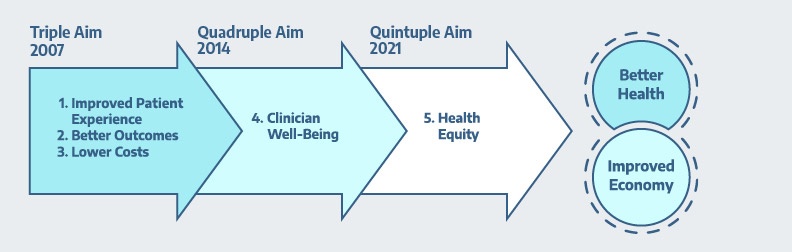
On paper, it is straightforward. In practice, achieving all five of these goals is far more challenging in today’s environment of rising costs, growing technical debt, and constant pressure to do more with less.
To put that challenge in perspective, U.S. healthcare spending was projected to reach $5.6 trillion in 2025, about 18% of GDP. At the same time, Americans are living shorter and sicker lives than people in other high-income countries. That is not the story of a system delivering better outcomes. It is the story of a system becoming more expensive while still struggling to give patients and clinicians what they need most.
I’m hearing this reality directly from healthcare leaders. In a focus group I led last month, I asked eight CIOs if their jobs were harder now than they were during the pandemic. Every single one said yes. These executives readily shared that the cost of healthcare IT is now encroaching on budgets that directly impact patient care. These budgets were meant to deliver better outcomes for more people without contributing to clinician burnout. Even when making the argument that great technology is great patient care, it’s becoming harder to lower costs while maintaining that promise.
Where Healthcare IT Fits into the Cost Crisis
There’s widespread agreement that technology plays a vital role in our individual health outcome. But there is a widening gap in our understanding of how and who should bear the cost burden.
The healthcare IT industry takes the Quintuple Aim principles and applies them to technology solutions that build the digital health framework. Climbing SaaS costs across the full IT stack fulfilled the promise of the cloud. However, subsequent subscription iterations led to technical debt. Post-pandemic, healthcare organizations are feeling the financial pressure from every angle:
- 37% of hospitals are losing money.
- Inflation and a tariff-impacted supply chain continue to strain budgets.
- Reimbursements are stagnating.
- IT budgets are hovering around 3% or less of overall hospital spend.
And as I write this, we are more than a month into a government shutdown centered on the future of Medicaid, another reminder of just how unstable the broader environment around healthcare financing really is.
How Dell Supports the Quintuple Aim Through Cost Recovery
Dell Private Cloud Infrastructure uses familiar building blocks like PowerEdge compute, PowerStore storage, and the Dell Automation Platform to help hospitals regain control of their environment and support patient care more efficiently. Below are a few of the key ways that shows up in practice.
1. Lower Total Cost and Efficient Resource Use
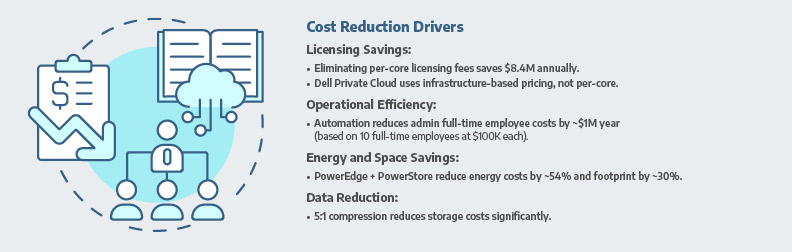
For many organizations, there is no mystery about where the money is going: too many boxes, too many cores, and too many licenses. By consolidating infrastructure, Dell Private Cloud reduces both the physical footprint and the number of VMware or Broadcom licensed cores you have to support.
Better utilization and built-in data reduction mean you are not paying to power, cool, and maintain resources you do not really need, which drives down total cost of ownership in a way that is very tangible to a CFO.
2. Freedom from Hypervisor and Vendor Lock-in
Healthcare IT leaders need options, not one more form of lock in. Dell Private Cloud supports VMware, Red Hat, Hyper-V, Nutanix, and containers so you can make decisions based on clinical and business needs, not just licensing changes.
Because compute and storage scale independently, you can grow where you need to grow without triggering yet another rip and replace cycle.
3. Modernized, Automated Operations
Most hospitals are running incredibly lean IT teams. The day-to-day work cannot rely on heroics anymore. With a single console through Dell Automation Platform, provisioning, lifecycle management, and updates become more predictable and far less manual.
That means fewer late night maintenance windows, fewer surprises during upgrades, and more time back for the projects that actually move the needle for clinicians and patients.
4. Ready for AI, Hybrid, and Multicloud Workloads
Whether your organization is piloting AI or machine learning at the edge, expanding containerized workloads, or navigating a hybrid or multicloud strategy, the underlying infrastructure has to keep up. Dell Private Cloud is built with those realities in mind, supporting performance hungry workloads while improving data reduction, observability, and operational efficiency.
In other words, you are not building yesterday’s data center and hoping it will handle tomorrow’s use cases.
5. Protecting Your Existing Investments
Very few healthcare organizations have the luxury of starting from scratch. Dell Private Cloud allows you to phase in existing PowerEdge servers and PowerStore storage instead of throwing away sunk costs.
For teams that prefer a consumption-based approach, Dell Apex and Dell Financial Services provide flexible models so you can modernize at a pace that aligns with your priorities.
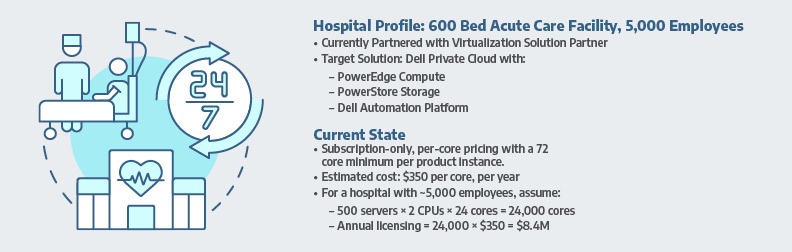
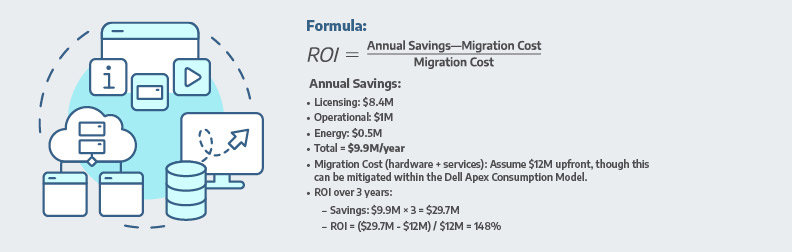
Dell Private Cloud Benefits
- PowerEdge Compute: Optimized for high-core density, reducing physical footprint and energy costs
- PowerStore Storage: Up to 30% faster workloads, 54% lower energy costs, and 5:1 data reduction guarantee
- Dell Automation Platform: Zero-touch onboarding, automated provisioning, and lifecycle management reduce operational overhead by 30–50%
- Healthcare-specific compliance: HIPAA, HITRUST, SOC2 built-in
Moving Forward with the Right Partner
Behind solutions like these are the people who help bring them to life. Connection has 17 team members dedicated exclusively to Dell and more than 225 individuals certified across technical and pre-sales tracks. Our Titanium Partner status and broad authorizations across Converged Infrastructure, Data Protection, Networking, Server, and Storage support more than 800 healthcare clients nationwide.
Every healthcare organization’s environment and priorities are unique. If you would like to explore a roadmap tailored to your organization, reach out to your Connection Account Executive or engage our Healthcare Practice to schedule time with our team.
*This is non-sponsored content.
Jennifer Johnson

Jennifer Johnson, Director Healthcare Strategy and Business Development, joined Connection in 2010 starting in field sales and joined the healthcare practice in 2015. Jennifer has more than 20 years in IT, including prior roles in distribution and manufacturing. Jennifer holds her Certified Digital Health Leader designation from the CHIME organization and is a member of HIMSS, where Connection is a diamond sponsor. Jen was named CRN Women of the Channel in 2023 and 2024 and holds certifications from NVIDIA (AI Advisor- Sales) and Dell Technologies (AI Champion- Partner Sales).