The factory is being rewritten while it runs. Not during a shutdown, not between model years, but in the middle of production, by people who cannot stop the line to do it.
Most manufacturers are managing that rewrite as three separate programs. There is a compute strategy, usually owned by IT. There is a security program, usually owned by a different group. And there is intellectual property creation and policy mapping, usually owned by a mixture of legal and engineering teams. Three owners, three budgets, three roadmaps.
That structure is the problem. These are not three programs. They are one system. Compute executes the value, security protects it, and intellectual property keeps creating more. Break the loop anywhere and the damage shows up somewhere else.
Four Ways the Loop Breaks
Run that system backward and you get four failure modes. Each one is worth planning around on its own, and none of them appears on an org chart.
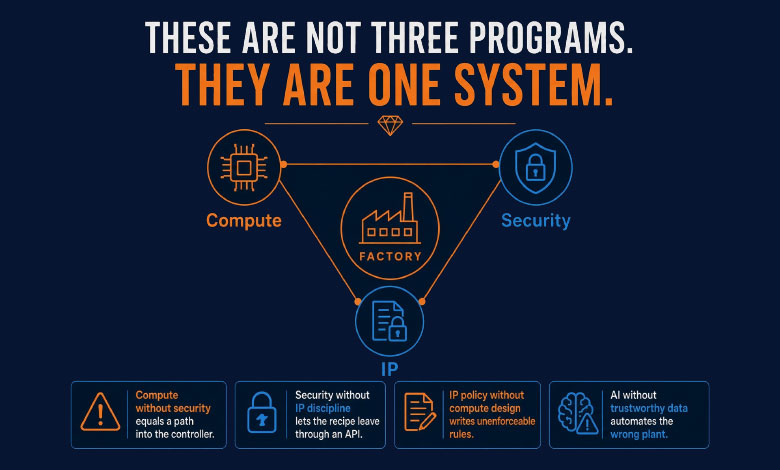
1. Compute without security is a path into the controller.
Wherever you add intelligence, you add an interface. An edge server that pulls telemetry off a line is also a device that can reach that line. The compute decision and the access decision are the same decision, made at the same moment, usually by someone thinking only about latency.
2. Security without intellectual property discipline lets the recipe leave through an API.
You can run a strong security program and still lose the thing that matters. Access controls protect systems. They do not, by themselves, protect the process knowledge moving through those systems to vendors, partners, and models. The traffic is authorized. The loss is real anyway.
3. Intellectual property policy without compute design writes rules nobody can enforce.
A policy that says proprietary process data must not leave the plant is a sentence, not a control. Whether it is true depends on where inference runs, what the model sends home, and which integrations are open. If the architecture cannot enforce the policy, the policy is a statement of intent.
4. AI without trustworthy data automates the wrong plant.
This is the quiet one. A model trained on data nobody validated will produce confident recommendations at scale, and the faster it runs, the faster the error propagates. Speed is not an asset when the direction is wrong.
The Physics of the Next Five Years
Underneath all of this sits a set of physical limits that will shape what is actually possible, regardless of strategy.

Chips are changing shape. More cores, smaller dies, disaggregated packages, high-bandwidth memory stacked next to compute. Performance density and power efficiency keep rising while cost per transistor falls. That is what makes serious inference at the plant edge affordable in the first place.
Power is the constraint most plans ignore. Transformers, grid capacity, power delivery, and thermal limits are now competing constraints on the same decision. You can buy the accelerators. Whether you can energize and cool them where you need them is a different question, and it has a lead time measured in quarters rather than weeks. Treat energy and heat rejection as capacity planning, because that is what they are.
Workloads are moving along one of three stages: predictive, which asks what will happen; prescriptive, which asks what we should do; and agentic, which asks what it will do. The value jumps at the last step, when systems move from recommending actions to owning outcomes. That is also where the governance requirements change completely.
And the plant itself is becoming software-defined: a factory platform that is versioned, reproducible, and auditable, with control logic, application layers, and field devices underneath it. That means programmable logic controller (PLC) code is code: tracked, versioned, and capable of rollback. The next five years will be shaped by physical limits and by the engineering systems built to work within them.
Train Centrally, Infer Locally, Govern Everywhere
The compute shift is not that manufacturers are adopting AI. It is where the work happens.
Training belongs in the cloud, where data, foundation models, and governance live together. Inference belongs at the plant, close to the process, where latency is measured against the line rather than against a service level agreement, and where the network may be air-gapped by design. Control belongs at the machine, in real time, in the place where a millisecond has a physical consequence.
What ties those layers together is policy that travels with the workload. A model trained centrally and deployed to 40 plants should carry its data residency rules, audit trail, and access controls into every one of them. Otherwise, governance stops at the edge of the building where it was written, which in practice means it stops entirely.
Above that sits the layer people are still figuring out: agents that perceive, plan, decide, act, and learn—coordinating across sites. That layer needs its own boundaries, because an agent with a goal and no constraint will find a way to meet the goal.

Design the Compute Estate Like a Production System
The useful mental shift is to stop treating compute as IT infrastructure and start treating it the way you treat a production line. Six principles follow from that.
- Classify every workload. Know what you run, why it matters, and where it belongs. Most organizations cannot produce this list on request.
- Build an industrial inference layer. Standardize, version, scale, and monitor inference as a repeatable production service rather than as a series of projects.
- Treat power and cooling as capacity. Energy, heat rejection, and infrastructure are first-class constraints and first-class enablers, not facilities line items.
- Put trustworthy data first. Ingestion, validation, lineage, and quality are non-negotiable foundations, and everything downstream inherits their weaknesses.
- Separate training from control. Isolate long-running exploration from real-time operations, for safety, reliability, and velocity. Both sides get better when they stop competing.
- Hire for systems, not tools. Build teams that can design, operate, and improve production systems end to end, rather than teams organized around individual products.
Reliability, repeatability, and responsibility scale together. If one of them is missing, the other two eventually stop working.
Four Doors that Used to Be Walls
Manufacturing is the most attacked industry in the world and has been for five consecutive years. IBM’s X-Force Threat Intelligence Index 2026 put the sector at 27.7 percent of all incidents it observed, ahead of finance and insurance. Data theft was the most common objective.
The reason is structural rather than bad luck. Four things that used to be separations are now connections:
- Identity moved from the office into the machine. The same directory that governs email now governs access to the line.
- The plant became software-defined. One control layer now reaches many physical lines, which is enormously efficient and enormously concentrated.
- AI is both an instrument and a target. The model that optimizes the process is also an asset worth stealing and a surface worth attacking.
- The supplier graph turned into one converged point of risk. Many suppliers, many integrations, one blast radius.

This is why most new operational technology incidents do not begin in operational technology. They begin at identity and multi-factor authentication, as well as with the VPN and helpdesk, and they arrive on the floor later. When they do arrive, the consequences are physical: Dragos incident data shows roughly three quarters of manufacturing ransomware cases disrupted operations, and a quarter caused a full site shutdown. On an automated assembly line, according to IIoT World, unplanned downtime can cost $2.4 million an hour.
The reframe worth carrying into budget conversations is that security is a production constraint, not a tax. It belongs alongside throughput, yield, and uptime, because it now behaves like them.
Resilience Is the Control Objective
Prevention is necessary and not sufficient. The objective is resilience, which means you design and test for it and then measure it. Four things follow:
- Assume breach of IT. Identity is the new perimeter, so multi-factor authentication, least privilege, and continuous verification are the baseline rather than the goal.
- Defend OT as OT. Operational technology systems are genuinely different, and they need protocol-aware monitoring, behavioral baselining, and anomaly detection rather than IT tooling pointed at a plant.
- Secure the AI layer. Treat models as supply-chain artifacts. Verify signatures, keep a signed model registry, monitor for drift, and make rollback possible.
- Recover as a capability. Immutable backups, versioned control logic with real history, and recovery you have actually practiced. Recovery you have never rehearsed is a plan, not a capability.
The Product Is No Longer Only the Part
Here is the shift that changes what there is to protect. Intellectual property used to be the drawing. Now it is the process: the recipe and its parameters, the digital twin that predicts how the part will behave, the model weights that encode learned behavior, and the design system that makes the whole thing reusable and evolvable.
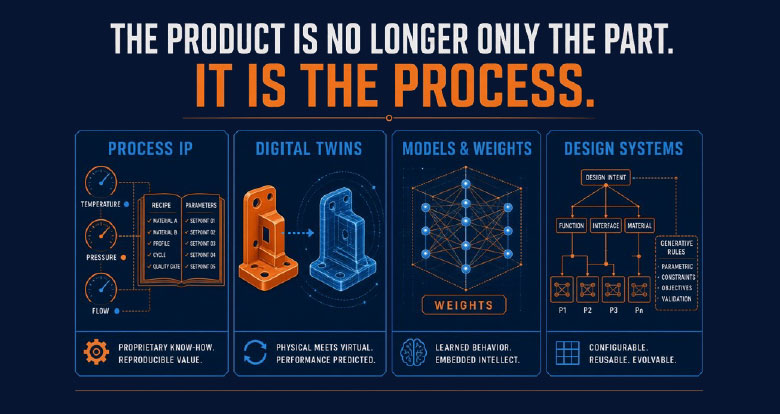
That means an adversary no longer needs your drawings. They need your process. And a process can be inferred from telemetry, reconstructed from a twin, or distilled out of a model, none of which requires anyone to walk out of the building carrying anything.
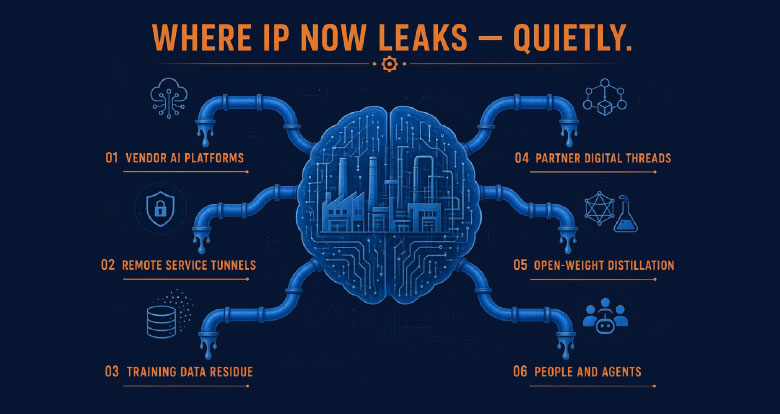
It also does not leave in dramatic ways. It leaves quietly, through six ordinary channels:
- Vendor AI platforms, where CAD geometry and process data go for analysis.
- Remote service tunnels, opened for maintenance and rarely closed.
- Training data residue, where proprietary parameters end up inside a model somebody else controls.
- Partner digital threads, where integrating with a supplier means sharing more than a part number.
- Open-weight distillation, where a model’s behavior can be extracted by querying it enough times.
- People and agents, both of which paste things into chat windows.
Treat the Plant Mind as a Classified Asset
If the process is the asset, it needs the treatment an asset gets. Six steps, in order:
- Inventory the intangible plant. Map tacit know-how, process models, and operational intuition as assets. Most organizations have never made this list.
- Classify by reconstructability. Score what could be reconstructed, inferred, or replicated from what you already expose, and label it accordingly.
- Put legal around the new objects. Ownership, trade-secret boundaries, and rights need to cover models and processes, not only drawings and documents.
- Apply technical controls to models. Isolate, encrypt, limit inference, and audit access to the models themselves.
- Treat version control as IP control. Lineage, changes, and provenance are what make a claim defensible later.
- Govern AI-assisted invention. Decide now who owns what a model helps create and how it gets reviewed and released.
None of that is exotic. It is the discipline already applied to physical assets, extended to the assets that now carry the value.
Secure the Factory You Are Becoming
The mistake worth avoiding is planning around the plant you have. Compute is moving to the edge, the control layer is consolidating, the supplier graph is widening, and the intellectual property is migrating into models and processes. All of that is already underway.
So the question is not whether to secure the factory—it’s whether you are securing the one that will exist in three years, or the one that has already stopped existing. Decide where the intelligence lives, who can reach it, and what is allowed to leave. Those three decisions are the whole program.
If you are working through where intelligence should live in your operation, the CNXN Helix® Center for Applied AI and Robotics helps manufacturers make those decisions in the right order. Talk to your Connection Account Team or start at cnxnhelix.com.
Jeff Minushkin

As a senior leader at the CNXN Helix® Center for Applied AI and Robotics, Jeff is tasked with the strategic coordination, marketing, development, and design of tailored and bespoke AI solutions in generative AI, vision AI, predictive AI, and natural language processing and machine learning. This includes overseeing professional services capabilities, including workshops in all things AI, regulatory and compliance, and AI cybersecurity, through delivery of digital transformation via products and services. His role is pivotal in delivering innovative product portfolios that not only advance the company’s objectives but also support its sales teams and cater to the needs of over 30,000 customers. Jeff is a technical- and operational-minded C-level executive who has led business and strategy for both established corporations and start-ups. He has a passion for developing innovative solutions to improve organizational performance and to deliver exceptional, award-winning products and services within varying industries. A comfortable communicator of a vision to the executive office, engineering team, or layperson, he has a proven ability to hire and motivate top talent, capitalize on strengths, and implement a vision to achieve business goals. With an uncompromising focus on high standards and operational success, Jeff covers a versatile set of experiences in all facets of business, from leadership to management, sales and marketing, operations, finance, and engineering.